TL;DR
How pedestrians really behave around mobility robots, measured in four crowd datasets on three continents.
For patients and clinicians
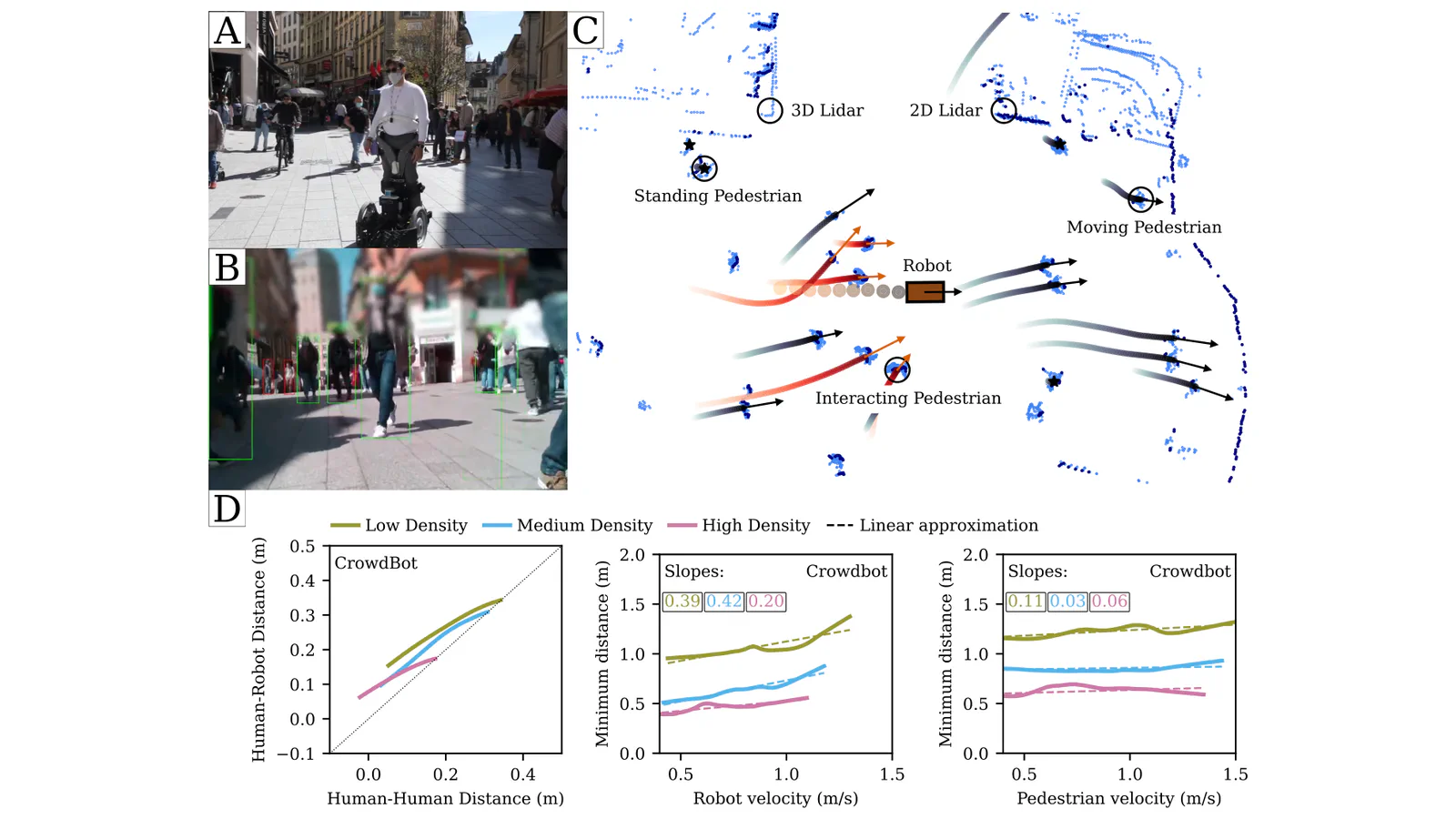
Delivery robots and robotic wheelchairs share pavements with people, but nobody had measured how pedestrians respond to them in real crowds. We compared human–robot with human–human encounters in four real-world datasets from Europe, North America and Asia. People move around robots much as they do around other people, but keep more distance from a robot: more so the faster it moves, less so the denser the crowd.
Key result: Around a fast-moving robot, pedestrians kept about 0.23 m more clearance than around other pedestrians in sparse crowds, and about 0.05 m more in dense crowds.
BibTeX
@article{wojcikiewicz2026assessing,
  title  = {Assessing pedestrian responses to autonomous and personal mobility robots in crowded public spaces},
  author = {Wojcikiewicz, D. and Billard, A. and Paez-Granados, D.},
  journal = {Science Advances},
  year   = {2026},
  doi    = {10.1126/sciadv.aef2576}
}Related papers
Beyond Leaderboard Scores: A Deployment-Focused Protocol for Interpretable Tracking Evaluation in Pedestrian-Centric Environments
arXiv preprint (under review) · 2026
Prox-Nav: Constrained Reinforcement Learning for Safe Social Navigation with Proxemic Constraints
IEEE/RSJ IROS 2026 · 2026