TL;DR
A graph-attention network that reads irregular, incomplete intensive-care time series and explains its risk predictions.
For patients and clinicians
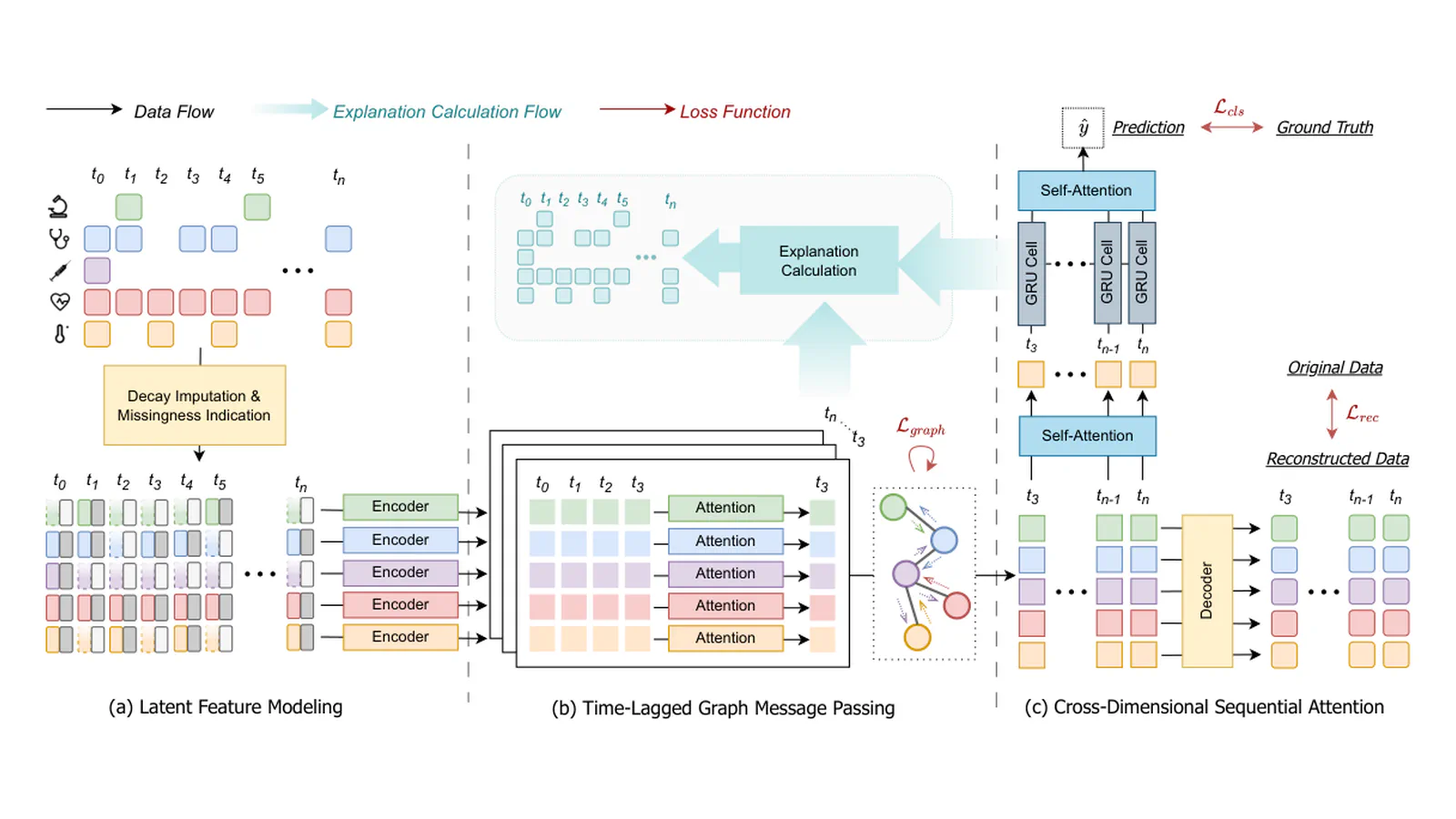
Intensive-care records are vital signs and lab values taken at irregular times, with many gaps. GARLIC fills the gaps with a learned decay model, learns which signals depend on which through a time-lagged graph, and reports which observations drove each prediction. On three public ICU benchmarks it predicts outcomes better than the best existing models at similar cost, and its explanations hold up when the features it ranks highest are removed.
Key result: New state of the art in AUROC and AUPRC on PhysioNet 2012, PhysioNet 2019 and MIMIC-III, with built-in observation-, signal- and edge-level explanations.
BibTeX
@inproceedings{wang2026garlic,
  title  = {GARLIC: Graph Attention-based Relational Learning of Multivariate Time Series in Intensive Care},
  author = {Wang, R. and Li, Y. and Günther, M. and Paez-Granados, D.},
  booktitle = {International Conference on Learning Representations (ICLR)},
  year   = {2026}
}