TL;DR
Autonomic dysreflexia detected from commercial wearables, without a blood-pressure cuff.
For patients and clinicians
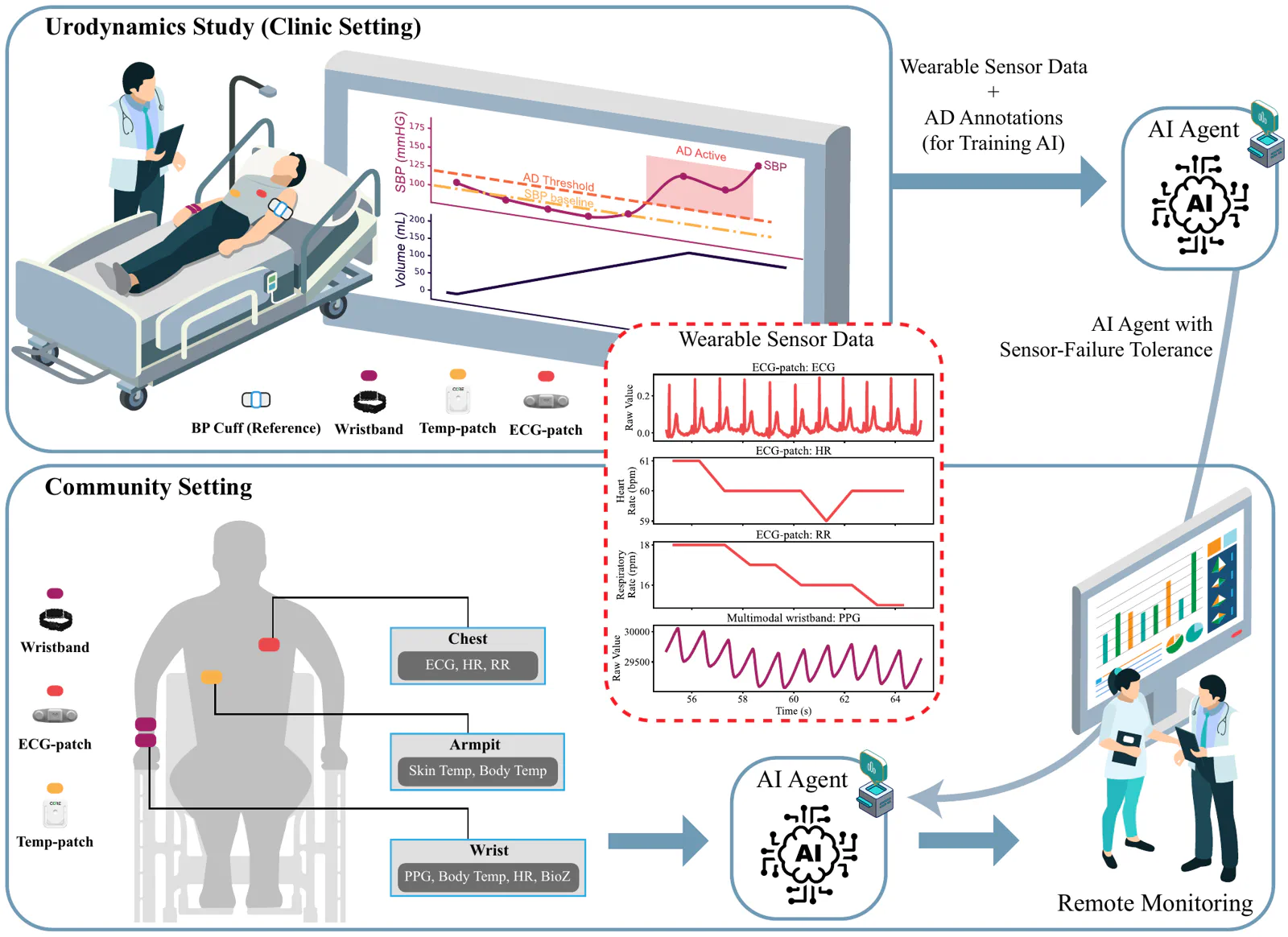
After a spinal cord injury, blood pressure can spike suddenly and dangerously (autonomic dysreflexia); today it is caught only with a cuff or by symptoms. We recorded 27 people with chronic injury with three commercial wearables during bladder examinations, where such episodes are common, and trained an explainable ensemble to recognise them from heart rate, ECG and PPG. The model stays robust when a sensor drops out.
Key result: Macro F1 0.77 ± 0.03 for detecting episodes; heart-rate features alone reach AUC 0.93, ECG 0.88, PPG 0.86.
Study: Outsense, Swiss Paraplegic Centre · BASEC 2023-00400
BibTeX
@article{ejtehadi2026robust,
  title  = {Robust learning framework for a scalable remote monitoring of autonomic dysreflexia: use-case in spinal cord injury},
  author = {Ejtehadi, M. and Fuchs, B. and Cisnal, A. and Pannek, J. and Scheel-Sailer, A. and Riener, R. and Eriks-Hoogland, I. and Paez-Granados, D.},
  journal = {Scientific Reports},
  volume = {16},
  pages  = {9618},
  year   = {2026},
  doi    = {10.1038/s41598-025-33797-8}
}Related papers
Monocular markerless biomechanics for clinically interpretable gait assessment in spinal cord injury
arXiv preprint (under review) · 2026