TL;DR
What it takes to trust a cuffless blood-pressure estimate from a wearable: a map of the field and a model-card reporting standard.
For patients and clinicians
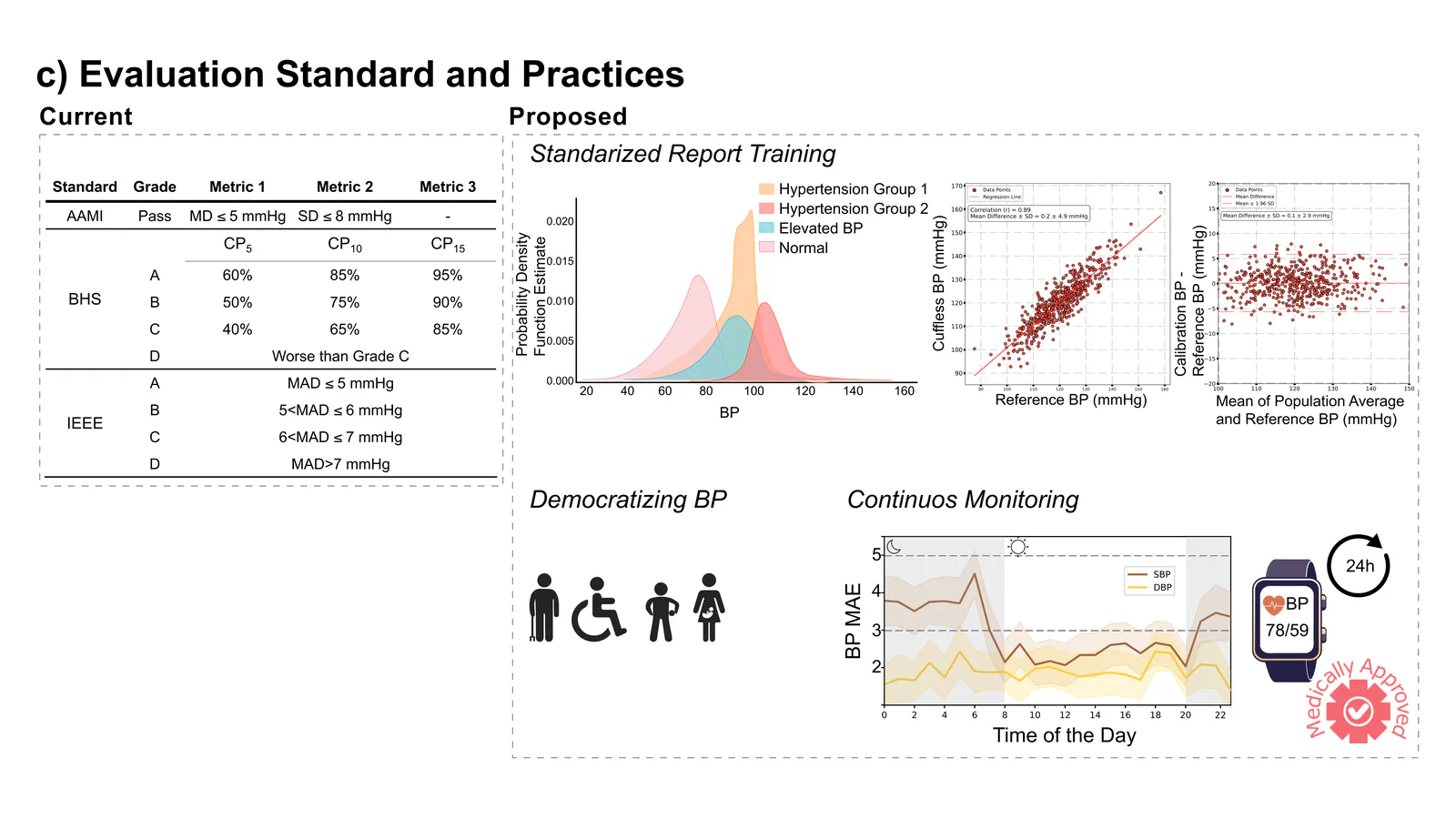
Watches and patches promise blood pressure without a cuff, but studies measure different signals, train models differently and report results that cannot be compared. We reviewed the field, organised it by signal, model and calibration strategy, and wrote a reporting checklist, modelled on AI model cards, so a cuffless device can be judged on protocol realism, calibration drift, population diversity and fairness before it reaches patients.
Key result: A unified taxonomy of cuffless blood-pressure methods and a model-card reporting framework for future studies.
BibTeX
@article{cisnal2026towards,
  title  = {Towards Trustworthy AI-driven Cuffless Blood Pressure Monitoring},
  author = {Cisnal, A. and Podder, I. and Grossmann, L. and Dheman, K. and Elgendi, M. and Valgimigli, M. and Paez-Granados, D.},
  journal = {npj Digital Medicine},
  year   = {2026},
  doi    = {10.1038/s41746-026-02898-7}
}Related papers
Monocular markerless biomechanics for clinically interpretable gait assessment in spinal cord injury
arXiv preprint (under review) · 2026