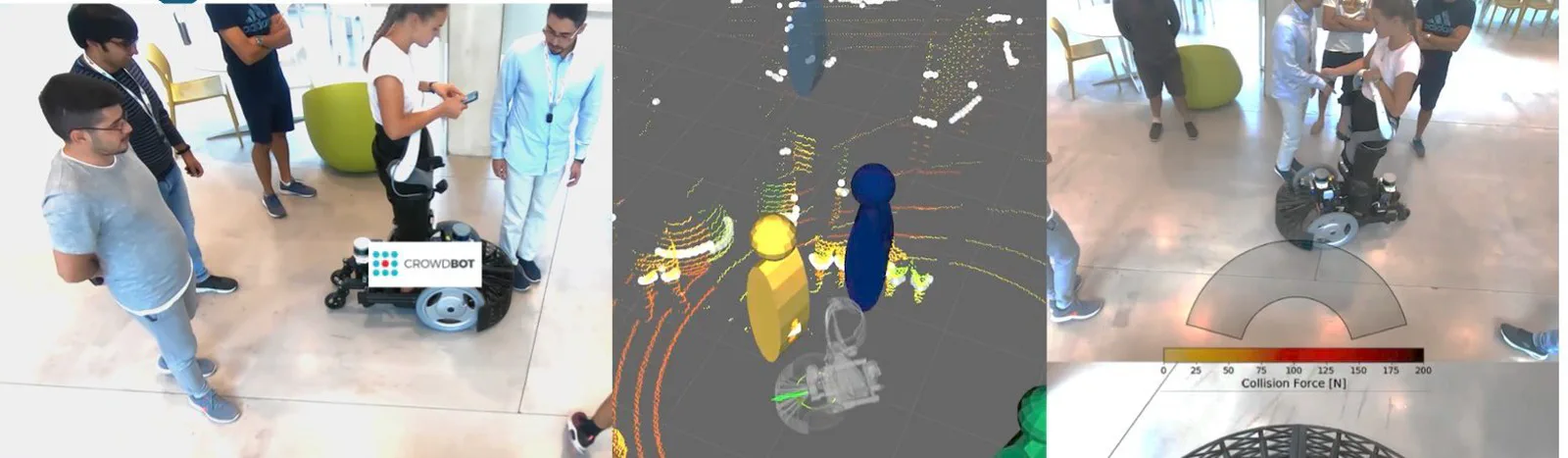
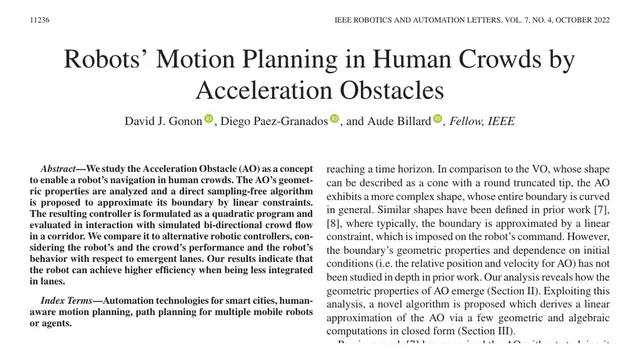
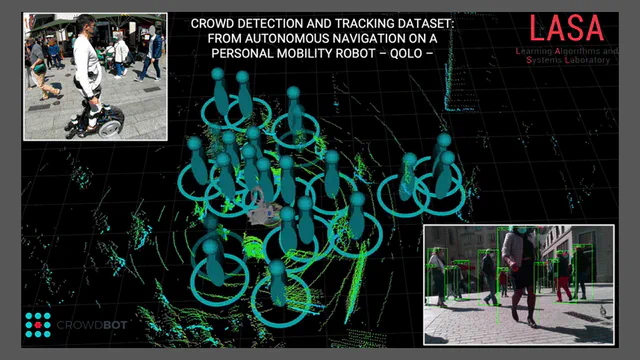
Safe navigation of the Qolo wheelchair in crowds, in the EU CROWDBOT project. We developed collision-aware control, measured injury risk in crash tests, and drove the wheelchair autonomously through crowded markets.
2019–2021completed
My role: Postdoctoral researcher, LASA, EPFL
Team & partners: Prof. Aude Billard (PI, EPFL) · University of Tsukuba
Funding: EU Horizon 2020
Background
Robots and powered wheelchairs that drive among pedestrians must avoid collisions and limit harm when contact occurs. LASA at EPFL and the AI Lab of the University of Tsukuba studied this with the Qolo standing wheelchair in the EU CROWDBOT project.
Aims
Assess the safety of Qolo in crowds, and develop shared and collision-aware control for robots that navigate among people.
Methods
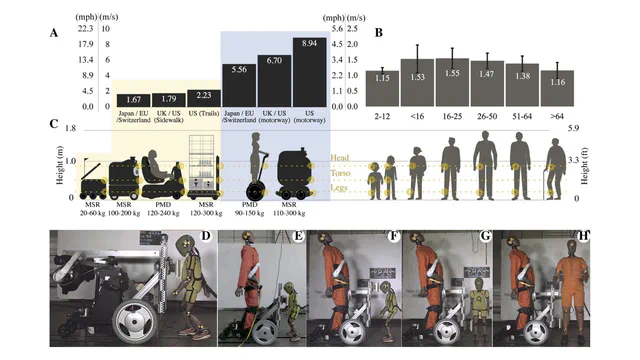
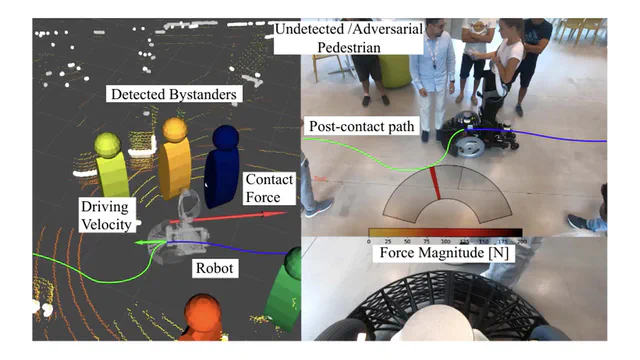
We formulated pre- and post-collision control as a closed-form dynamical system, so the robot controls its motion both before and after contact. We measured injury risk for adults and children in crash tests with personal mobility devices and service robots. We drove Qolo autonomously through Christmas and farmers’ markets with the CROWDBOT perception and control pipeline, and released the recorded pedestrian data as an open dataset.
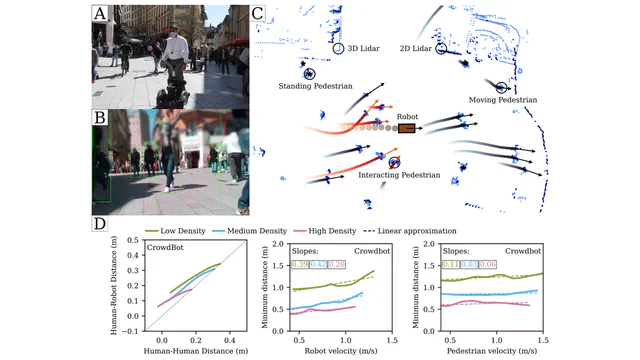
How pedestrians really behave around mobility robots, measured in four crowd datasets on three continents.
For patients and clinicians
Delivery robots and robotic wheelchairs share pavements with people, but nobody had measured how pedestrians respond to them in real crowds. We compared human–robot with human–human encounters in four real-world datasets from Europe, North America and Asia. People move around robots much as they do around other people, but keep more distance from a robot: more so the faster it moves, less so the denser the crowd.
Key result: Around a fast-moving robot, pedestrians kept about 0.23 m more clearance than around other pedestrians in sparse crowds, and about 0.05 m more in dense crowds.