Research projects since 2014

Projects

Projects from robotics to clinical AI. Current SCAI Lab projects link to their page on the lab's website (↗ SCAI Lab); earlier projects from Tohoku, Tsukuba and EPFL have their own page here.

Neurocomputation of movement & function

Personalized orthotic design ↗ SCAI Lab
2024–2026 activeInnosuisse

Personalized orthoses for people with walking impairments, developed with an industry partner. We estimate each orthosis's effect on the wearer's gait with subject-specific musculoskeletal models.

Remote gait assessment ↗ SCAI Lab
2024– activeETH Zürich · Swiss Paraplegic Foundation

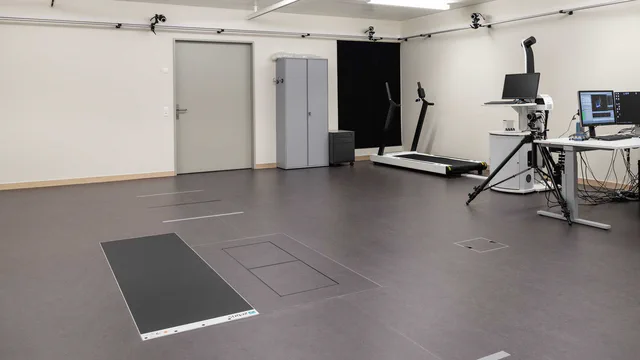
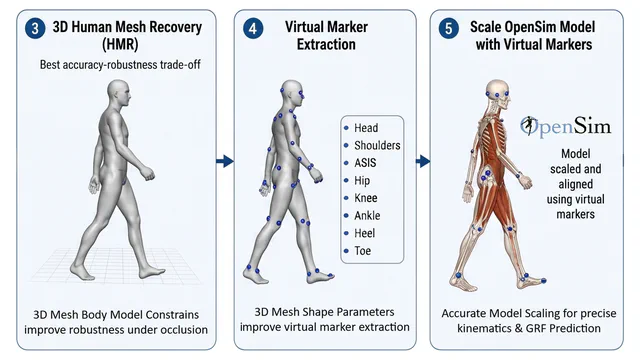
Gait assessment from ordinary video to predict rehabilitation outcomes after spinal cord injury. We estimate 3D joint angles and ground-reaction forces from a single camera, validate them against motion capture in 239 people, and cluster gait patterns with unsupervised time-series learning.

Real-time physiological state estimation

WEAR-HF: digital biomarkers in heart failure
2026–2027 activeFondazione Aldo e Cele Daccò

Wearable measurements in heart failure, with the Ente Ospedaliero Cantonale (EOC) in Lugano. We record wearable signals in a clinical study planned for 100 patients and derive digital biomarkers from them.

Continuous bladder-function monitoring ↗ SCAI Lab
2025–2027 activeSNSF Bridge · ETH RESC · Innosuisse (URO-PATCH)

Led by Dr. Kanika Dheman, Project Based Learning Center (PBL), D-ITET, ETH Zürich

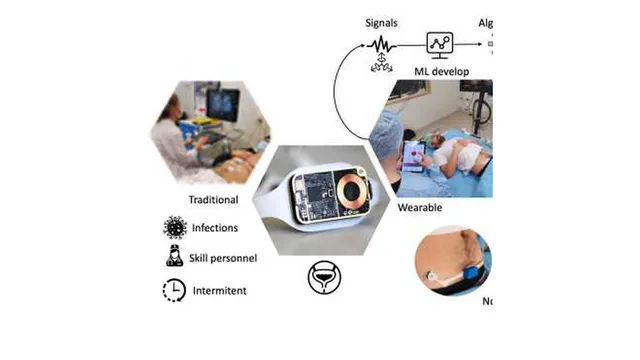
A wearable sensor that tracks bladder volume without a catheter, for people with spinal cord injury, led by Dr. Kanika Dheman (PBL, ETH Zürich). We measure bladder bioimpedance, fuse it with further sensors, and validate it during urodynamic examinations and in daily life.

Blood-pressure sensing system for spinal cord injury ↗ SCAI Lab
2025–2027 activeSwiss Paraplegic Foundation (SPS-FOKO)

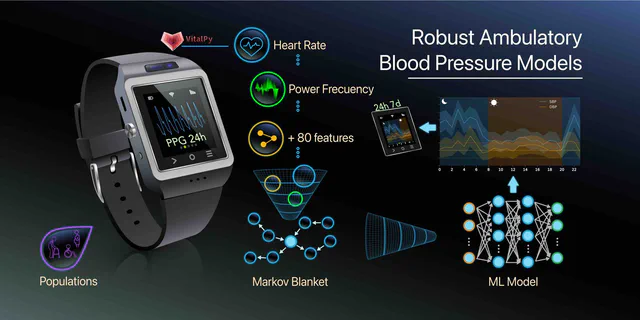
Wearable monitoring of blood pressure and autonomic dysreflexia in people with spinal cord injury. We estimate blood pressure from ECG and PPG with transfer learning from a large dataset of healthy people, and detect dysreflexia from skin temperature, electrodermal activity and blood oxygen.

Lifelog for digital twins in healthcare robotics ↗ SCAI Lab
2023–2026 activeJST Moonshot (JPMJMS2034)

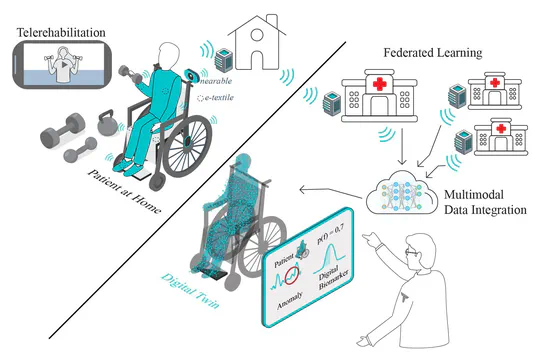
Digital twins of people with spinal cord injury and of older adults in nursing care, built from wearable and home data. We model daily activities and cardiovascular function with graphical models, and train them across clinics with federated learning.

Remote patient monitoring in spinal cord injury ↗ SCAI Lab
2024– activeETH Zürich · Swiss Paraplegic Foundation (Digital Transformation in Personalized Health Care for SCI)

Remote monitoring of people with spinal cord injury in daily life, to detect cardiovascular, urinary and skin complications early. We combine wearable and nearable sensors with clinical records, and model each person's health status with machine learning.

Causal graphical modelling of disease progression ↗ SCAI Lab
2022–2025 completedETH Zürich · Swiss Paraplegic Foundation (SCAI Lab)

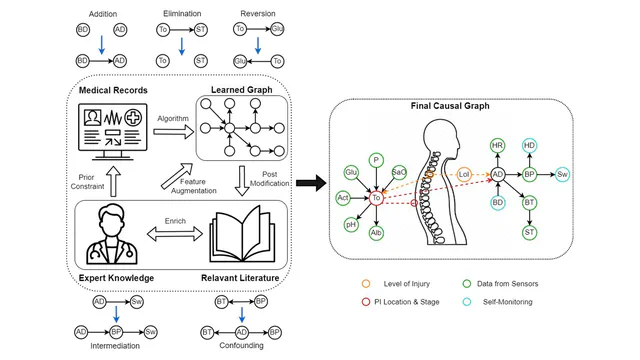
Prediction of complications during rehabilitation after spinal cord injury, starting with pressure injuries. We learned causal graphs from hospital records and vital signs, added expert knowledge to the discovery step, and used the graphs to select the inputs of risk models.

Adaptive assistive technology & interventions

Robotic wheelchairs in complex environments ↗ SCAI Lab
2023–2024 completedInnosuisse

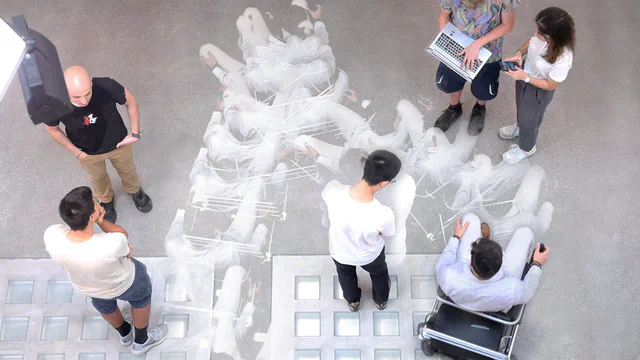
Robotic wheelchairs that move safely among people. We developed shared control between user and robot, tracked pedestrians from onboard sensors, and measured how pedestrians respond to mobility robots in public spaces.

FMW: force measurement wheel for shoulder-load monitoring
2023–2025 completedETH RESC Foundation

An instrumented wheel for manual wheelchairs that measures push-rim forces in daily life, to support propulsion techniques that protect the shoulder. We built a lightweight force measurement wheel and used it with 10 wheelchair users to measure push-rim forces and classify daily activities.

EU CROWDBOT
2019–2021 completedEU Horizon 2020

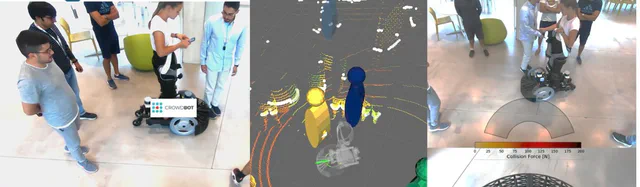
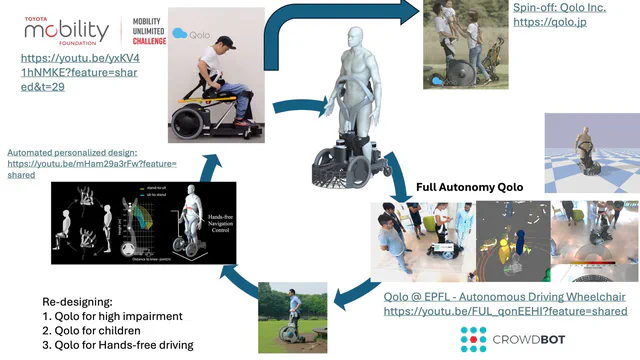
Safe navigation of the Qolo wheelchair in crowds, in the EU CROWDBOT project. We developed collision-aware control, measured injury risk in crash tests, and drove the wheelchair autonomously through crowded markets.

Qolo: quality of life with locomotion
2018–2020 transferredToyota Mobility Foundation (Mobility Unlimited Challenge, finalist)

A standing wheelchair that lets people with lower-limb paralysis move and talk at eye level. We designed a passive exoskeleton that uses upper-body motion to stand up, and a hands-free interface that steers with the torso.

DANTE: robot dance teacher
2014–2017 completedMEXT Japan

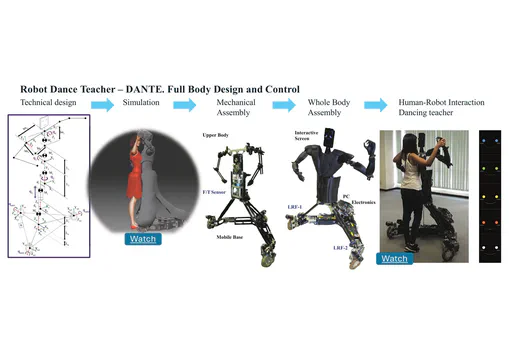
A dance-teaching robot that leads a human partner through physical contact. We built the robot and a force-based controller that adapts its guidance to the partner's skill, and tested it with several participants.

Open-source software

ROS 4 Healthcare · 2026

Open ROS framework for physiological human sensing in assistive, rehabilitation and medical robotics.

KarmaTS · 2025

Simulation platform for multivariate time series with functional causal dynamics.

MedWear · 2025

Open platform for medical wearable data interoperability and API integration.

Tifex-Py · 2025

Time-series feature extraction for Python, benchmarked on human activity recognition.

VitalPy · 2024

Python library for wearable vital-sign processing (PPG preprocessing and 400+ features).

Clinical studies

Active, 2025 Cardiovascular function monitoring in the SCI community (iAD)
SPZ · n = 120 · BASEC 2025-00165 · related paper
Active, 2024 Bio-impedance bladder volume sensing
SPZ + ETH · n = 61 · BASEC 2024-01254 · related paper
Active, 2024 Pilot human motion capture for cerebral palsy
ETH + SPZ · n = 50 · BASEC 2024-02470
Active, 2024 WEAR-HF: wearable measurements in heart failure
EOC · n = 100 · BASEC 2024
Active, 2023 NCGG biosensors & long-term monitoring with robotic care devices
NCGG · n = ≤100 · NCGG IRB #1692 · related paper
Completed, 2026 Retrospective analysis of orthosis designs (ankle-knee)
ETH + SPZ · n = 100 · BASEC 2026-00215 · related paper
Completed, 2025 SCAit: gait in ambulatory SCI patients
SPZ · n = 250 · BASEC 2022-00935 · related paper
Completed, 2025 FMW: wheelchair propulsion force measurement
ETH + SPZ · n = 10 · BASEC 2024-02184
Completed, 2025 Outsense: remote biosignal monitoring in SCI
SPZ + ETH · n = 20 · BASEC 2023-00400 · related paper
Completed, 2024 Hospital-acquired pressure injury in SCI
SPZ · n = 250 · BASEC 2019-02179 · related paper
Completed, 2024 Post-surgery pressure ulcers in SCI (cohort)
SPZ · n = 266 · BASEC PB_2016-00975

Sites: SPZ, Swiss Paraplegic Centre, Nottwil · ETH, ETH Zürich · EOC, Ente Ospedaliero Cantonale (Cardiocentro Ticino), Lugano · NCGG, National Center for Geriatrics and Gerontology, Japan. All studies run under approved ethics protocols with informed consent.